
Some people wonder whether the climate crisis is real. Hasn’t Earth’s climate always changed? Yes, it has, and there are valid reasons why our climate has gone through periods of warming and cooling for millennia. We are now in a warming period, and this one is caused by an increase in greenhouse gases in the atmosphere from the burning of fossil fuels. This is well-known, hard science. It doesn’t matter what you believe; the climate is warming, and seas are rising. It is happening. And it is a crisis.

Flash flood, Texas, July 2025. Photo credit Shutterstock, Adansijav Official
Extreme Weather Events Linked to Climate Change
Are we witnessing more flooding, droughts, wildfires, and extreme heat because of climate change? Indeed, we are! In the United States alone, we had the Texas flood, June 2025, death toll 129, and rising; the Los Angeles wildfires, January 2025, death toll 30; and the Maui wildfires, August 2023, death toll 102. Heat related deaths here have increased 117 percent between 1999 and 2023, to an average of 2,325 per year.
The hottest year on record for the planet was 2024; the next hottest was 2023. The 10 hottest years on record were the last 10. Again, the 10 hottest years on record were the last 10.

Los Angeles wildfire, January 2025. Photo credit Shutterstock, Eley Archive
Indisputable Evidence
Carbon dioxide levels have been measured continuously since 1958 at the Mauna Loa Observatory in Hawaii. These measurements are the most indisputable evidence of human-induced climate change. In 1958, the atmospheric CO2 level was 313 ppm. Today it is 428.
Analysis of air bubbles trapped in ice core samples has shown that the carbon dioxide level in the atmosphere is the highest it has been for at least 800,000 years.
Atmospheric concentration of all four greenhouse gases—carbon dioxide, methane, nitrous oxide, and sulfur hexafluoride—has increased because of the burning of fossil fuels.
This is empirical data. Science. It doesn’t lie.
Climate Crisis Terms
When I was young, I had never heard of the terms now used to describe climate crisis events, such as heat domes, atmospheric rivers, bomb cyclones, or hydroclimatic whiplash. These are now common occurrences.
Climate Creep
I’m 70 years old. How did that happen? Seems like yesterday I was 40. Every year, we get a little older, and we hardly notice. Many never notice how much a tree grows in a single year or the tiny insects slowly compromising its health. Although it’s been hard to notice, the tree is dying and will soon come crashing down.
Climate change happens slowly and incrementally over time. As we humans pump more and more greenhouse gases into the atmosphere, it traps heat which causes our weather to get warmer and weirder.
Let me share a few observations that further prove that the climate crisis is real.
Smoke From Canadian Wildfires
In 2023, smoke from Canadian wildfires descended into the Shenandoah Valley. I remember thinking “this should be a wake-up call.”
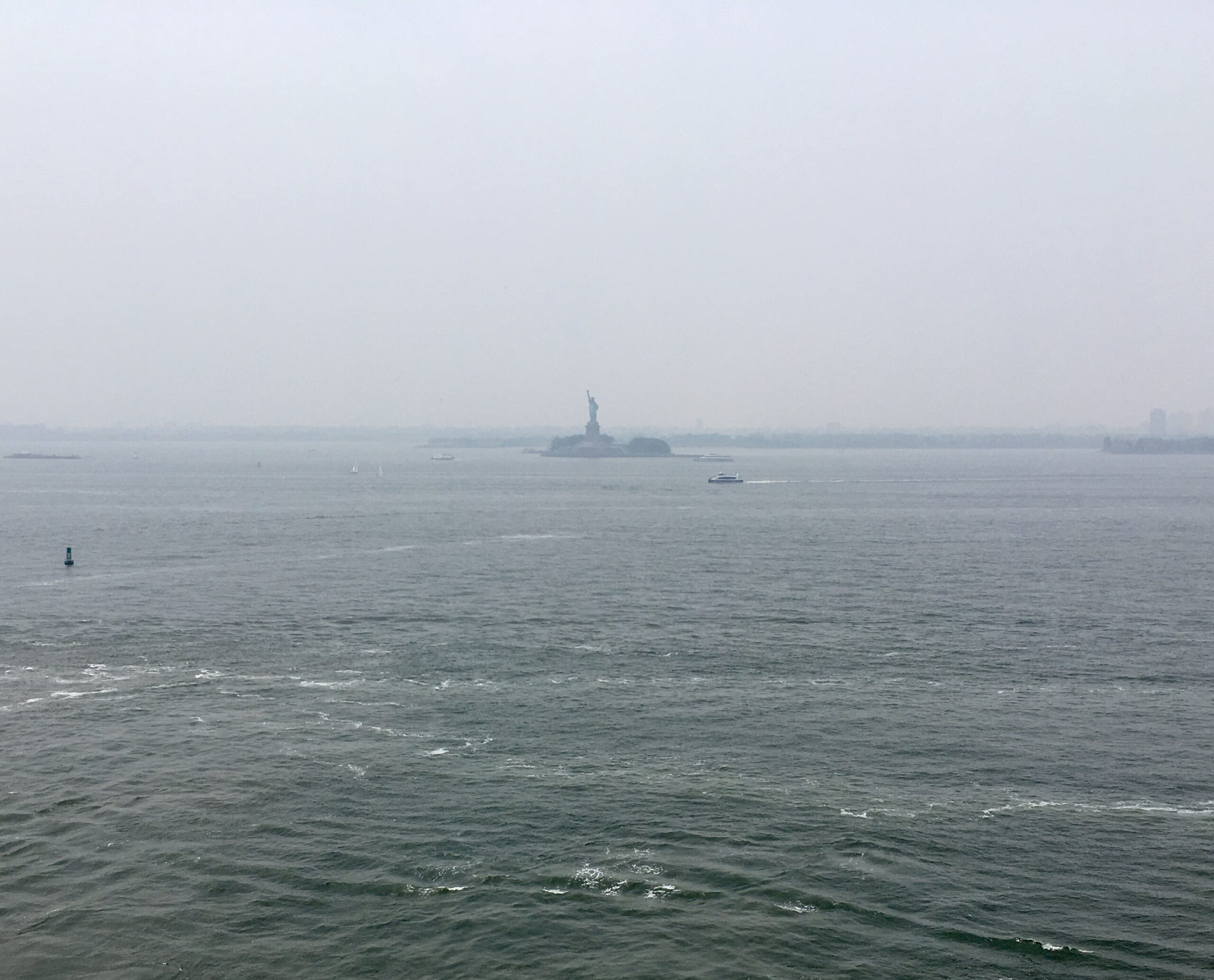
The Statue of Liberty in the New York Harbor shrouded in smoke from the wildfires in Canada. Photo credit R. Whitescarver
Snow Geese and Assateague National Wildlife Refuge
In the 1980s, I would travel to Assateague National Wildlife Refuge the third week of November every year to witness the grandeur of tens of thousands of migrating Snow Geese. Forty years later, I returned the same week in November. There were no Snow Geese. I was so disappointed that I went to the visitor center to ask a ranger what had happened. She said, “You’re a birder; you must know about climate change. All the Snow Geese are still up north. It’s not cold enough here for them yet.”

Murmuration of Snow Geese. Photo credit Shutterstock, Edmund Lowe Photography
Studies show that the ranges of many North American bird species have moved north at a rate of almost one mile per year (.9 mi).
Tangier Island and Sea Level Rise
Forty years ago, I camped in a pine forest on the eastern part of Port Isobel, an island next to Tangier in the Chesapeake Bay. Today, that forest is underwater. Tangier has lost two-thirds of its land to sea level rise and subsidence. A loss of 8.4 acres per year.

Tangier Island has lost two-thirds of its land since 1850 due to sea level rise and land subsidence. Photo credit Shutterstock
Plant Hardiness Zone Map
The USDA publishes the Plant Hardiness Zone Map. Farmers and gardeners use the map to select plants and seeds that grow best in their zone. First published in 1960, the map has been updated several times to reflect warming temperatures. USDA scientists have projected that zones will warm at a rate of 13 miles northward per decade.
French Grapes in England
A generation ago, England was not known for its wine. Today there is an explosion of wineries–the French are growing their pinot noir and chardonnay grapes there because of the warmer climate. “ ‘It doesn’t sound like a lot, does it? One degree?’ said meteorologist Stephen Dorling, who studies British viticulture. But it makes all the difference to a pinot noir vine, which needs 14 degrees Celsius, not 13 degrees Celsius, to thrive,” wrote William Booth in The Washington Post, 10/28/2024.
Solve The Crisis
It is frustrating that we have climate skeptics, politician naysayers, and “alternative facts.” And it’s hard for me to believe that we can solve this problem when we can’t even ban plastic straws or recycle glass bottles.
We need to pay attention to the science not the nay-saying politicians. We need to get busy and as the Once-ler said in Dr. Seuss’s The Lorax, “Unless someone like you cares a whole awful lot, nothing is going to get better. It’s not.”
Here are a few suggestions how you can get involved and help solve the climate crisis:
- Run for office. Elect politicians who trust science, not conspiracy theories. Vote for conservation and renewable energy.
- Support renewable energy. Go solar. Convert to electric appliances.
- Make your next car a hybrid or all electric.
- Support nonprofit conservation organizations.
- Require data centers to supply their own energy.
- Support local journalism and local businesses.
- Go to demonstrations. Make good trouble. Get involved.
- Plant trees!


Leave a Reply
Your email is safe with us.